Skip Navigation Links www.nws.noaa.gov 
NOAA logo - Click to go to the NOAA home page National Weather Service   NWS logo - Click to go to the NWS home page
Climate Prediction Center

Outlooks
   Drought Discussion
   Archive
   U.S. Monthly Temp.
      & Prec.

   U.S. Seasonal Temp.
     & Prec.

   Verification

Monitoring and Data
   GIS Data
   U.S. Weekly Drought       Monitor
   Drought
   Soil Moisture

About Us
   Our Mission
   Who We Are

Contact Us
   CPC Information
   CPC Web Team

 
HOME > Expert Assessments > Drought Information > Seasonal Drought Outlook


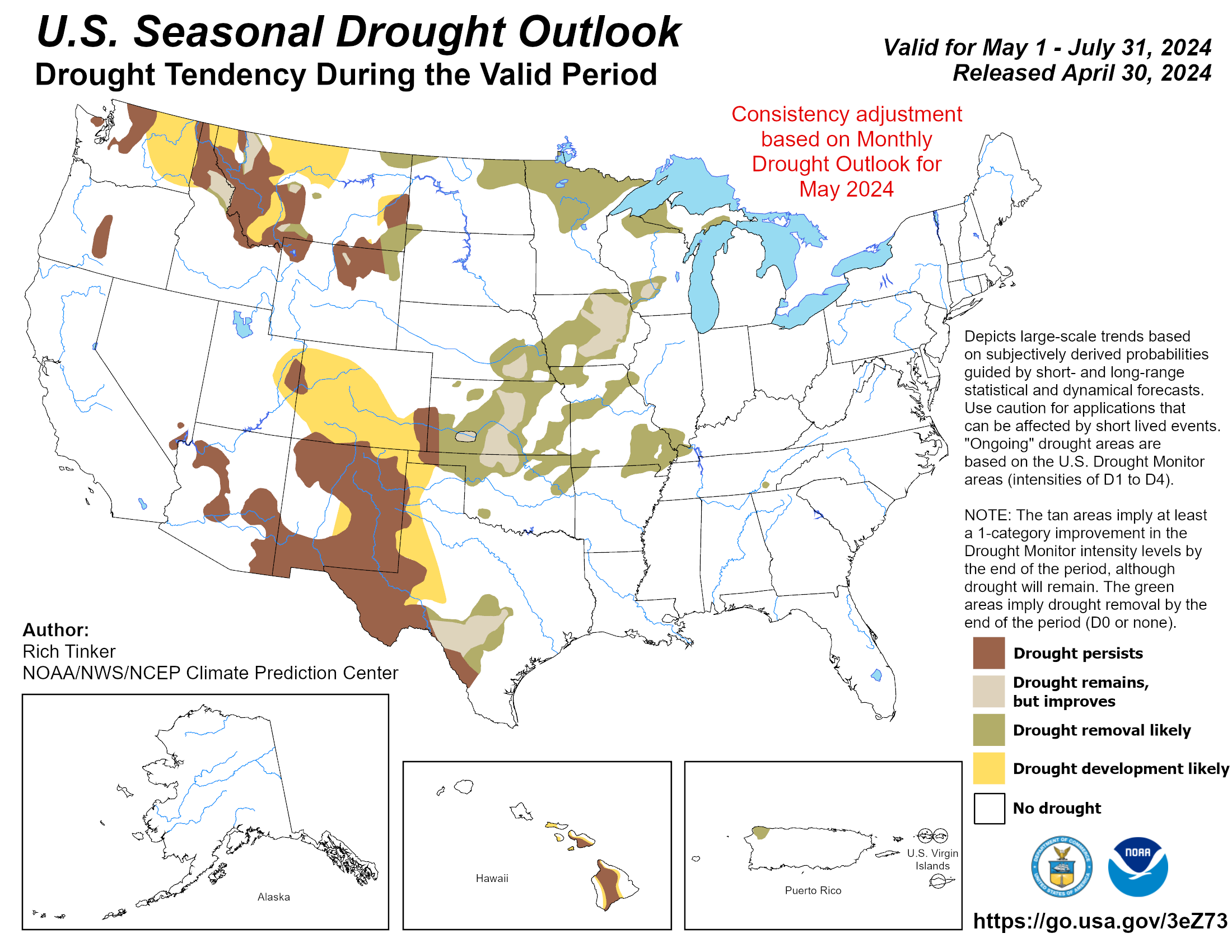
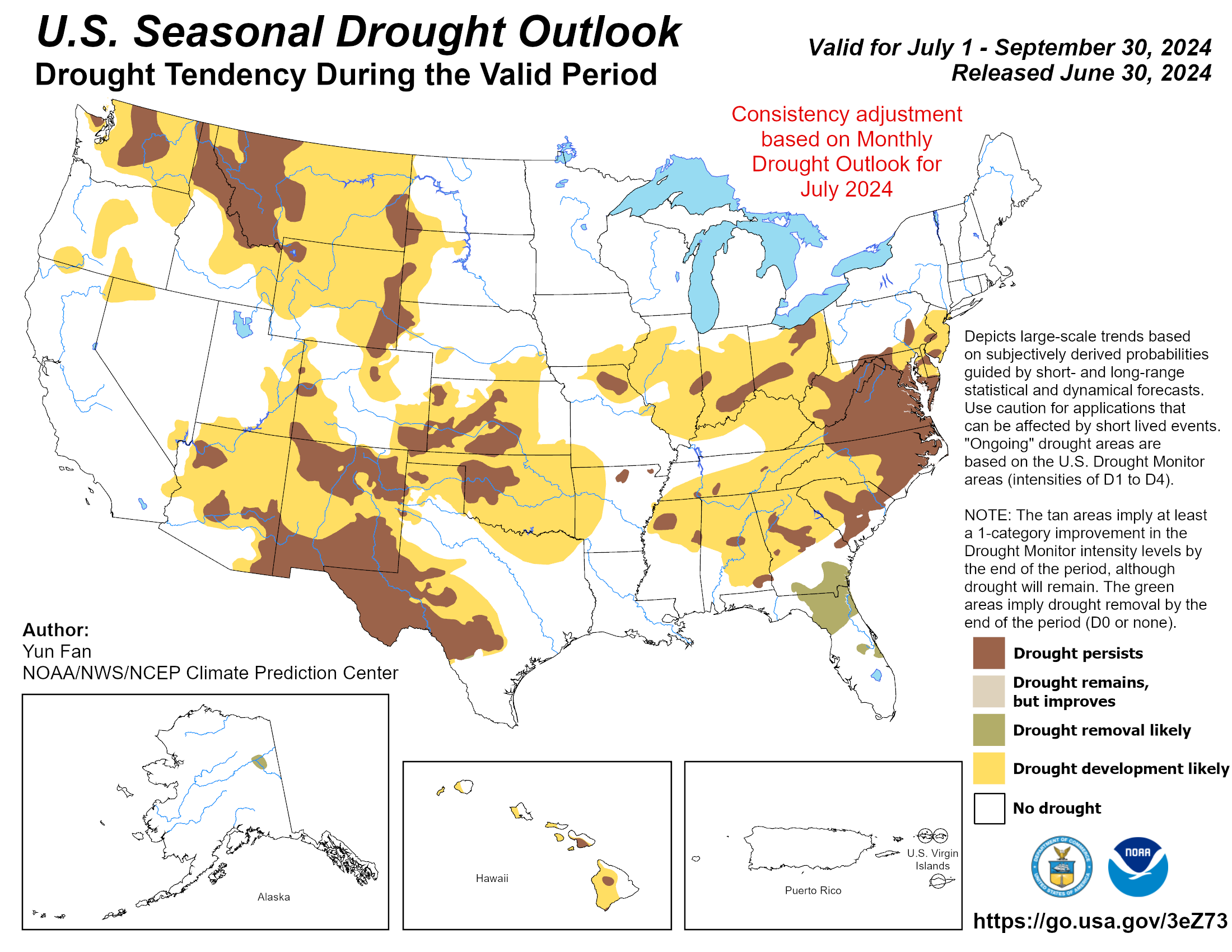
United States Seasonal Drought Outlook Graphic - click on image to enlarge
(Click on image to enlarge)
 
PDF Version of Seasonal Drought Outlook Graphic Adobe PDF Reader
 

Heavy to excessive precipitation is forecast from the southern Lower Mississippi Valley eastward across most of Georgia and across the Carolinas. At least 2 inches is expected here, with totals locally exceeding 5 inches possible from southern Louisiana into central Georgia. Several deterministic models and the updated official December precipitation forecast favor above-normal amounts for the month as a whole as well. Forecasts for January and February are less definitive, so the December-February Seasonal Drought Outlook has been adjusted from the Lower Mississippi Valley into the mid-Atlantic region to removal or improvement, rather than persistence and adjacent development. It is possible that drought will reintensify across the reason during the first two months of 2026, but given the low human and evaporative demand this time of year, and re-intensification or development is more likely after winter. Farther west, development in the higher elevations of Colorado has been retracted given less indications for dryness. The development forecast farther east and southeast over the lower elevations remains due December and winter being drier times of the year, which is not the case farther west across the Rockies. Across the northern tier of the Contiguous U.S., the persistence forecasts for the lower elevations of Montana and northern Maine have both been rescinded in favor of removal or improvement, given somewhat stronger indicators for above-normal precipitation.

Updated Seasonal Assessment - Heavy to excessive precipitation is forecast from the southern Lower Mississippi Valley eastward across most of Georgia and across the Carolinas. At least 2 inches is expected here, with totals locally exceeding 5 inches possible from southern Louisiana into central Georgia. Several deterministic models and the updated official December precipitation forecast favor above-normal amounts for the month as a whole as well. Forecasts for January and February are less definitive, so the December-February Seasonal Drought Outlook has been adjusted from the Lower Mississippi Valley into the mid-Atlantic region to removal or improvement, rather than persistence and adjacent development. It is possible that drought will reintensify across the reason during the first two months of 2026, but given the low human and evaporative demand this time of year, and re-intensification or development is more likely after winter. Farther west, development in the higher elevations of Colorado has been retracted given less indications for dryness. The development forecast farther east and southeast over the lower elevations remains due December and winter being drier times of the year, which is not the case farther west across the Rockies. Across the northern tier of the Contiguous U.S., the persistence forecasts for the lower elevations of Montana and northern Maine have both been rescinded in favor of removal or improvement, given somewhat stronger indicators for above-normal precipitation.

Latest Seasonal Assessment - During the past month, periods of heavy precipitation across the West led to widespread drought reduction across both the Northwest and Southwest, while drier conditions across Oregon and Idaho led to some drought expansion. Despite the heavy precipitation, above-average temperatures limited snowpack development across the Cascades, Sierra Nevadas, and Rockies, which could lead to drought concerns later in the Spring and Summer months should subsequent events also fail to generate substantial mountain snow cover. An active pattern and cold temperatures led to unusually heavy snow cover across the Midwest, Great Lakes, Corn Belt, and Northeast by early December, leading to areas of drought improvement. Dry conditions returned to much of the mid-Atlantic states, however, leading to a re-expansion of stubborn short term drought conditions. Across the Northeast, long-lasting drought conditions have impacted reservoir, streamflow, and groundwater levels, making forecast climatological precipitation, albeit generous, less likely to effect substantive improvements through the winter months. Across the Southeast, frontal systems brought some relief to the hardest hit drought areas, but extensive drought conditions continued and worsened in areas that missed out on the precipitation.


During the remainder of December, continued atmospheric river events are expected to bring copious moisture to the West, with affected areas extending southward across Oregon and California while continuing across the Northwest. The seasonal outlook matches well with typical climate anomalies associated with La Niña conditions, favoring wetness across the northern tier and below-normal precipitation across the southern tier. Based on these outlooks, drought improvement is favored for the Northwest and northern Rockies, while any drought development may be slowed across California and Nevada, except for portions of the desert Southwest. Despite the wet signal, drought improvements will likely be slower to occur across the northern Plains and upper-Midwest, where soils and streams have frozen over for the winter. A favored storm track across the mid-Mississippi and Ohio Valley regions favors drought reductions extending from eastern Arkansas through the Great Lakes region. In contrast, a drier signal along the southern tier favors persistence and drought development across the south-central CONUS, the Gulf Coast, Florida, and the southern Atlantic piedmont and coastal plains. Drought persistence is also favored for Maine, eastern New England, and the mid-Atlantic states due to frozen ground across New England and the notable impacts to groundwater, which may be slow to recover absent a clear and strong wet signal.


Outside of the contiguous United States, abnormal dryness is slowly materializing across northwestern Alaska due to a lack of snow cover, with impacts primarily to winter transportation. No additional drought development is anticipated due to the cold time of year and lack of sunlight. Across Hawaii, above-normal precipitation is favored, which can lead to drought improvements across the northwestern islands. Drought persistence is maintained for the Big Island, however, where precipitation probabilities are lower and the drought has been more intractable. Although abnormal dryness has expanded across Puerto Rico and the Virgin Islands and may lead to some short term drought development, forecast guidance is fairly wet over the next few weeks, which should preclude any widespread development across the northern Caribbean region.


Forecaster: Adam Allgood


Next Seasonal Drought Outlook issued: January 15, 2026 at 8:30 AM EST

Seasonal Drought Outlook Discussion


NOAA/ National Weather Service
National Centers for Environmental Prediction
Climate Prediction Center
National Center for Weather and Climate Prediction
5830 University Research Court
College Park, Maryland 20740
Page Author: Climate Prediction Center Internet Team
Disclaimer
Information Quality
Credits
Glossary
Privacy Policy
Freedom of Information Act (FOIA)
About Us
Career Opportunities