|
|
Forecast Tools
|
Verification
|
Related Outlooks
|
About Us
|
Contact Us
|
As of the May 19th, 2017, release, Week 3-4 outlooks precipitation outlooks are experimental, whereas the temperature outlooks are operational. Both are issued Friday between 3pm & 4pm Eastern Time.
|
|
|
HOME>
Outlook Maps>
Week 3-4 Outlooks
|
|
|
Week 3-4 Outlooks
|
Valid: 26 Sep 2026 to 09 Oct 2026
Updated: 11 Sep 2026
|
|
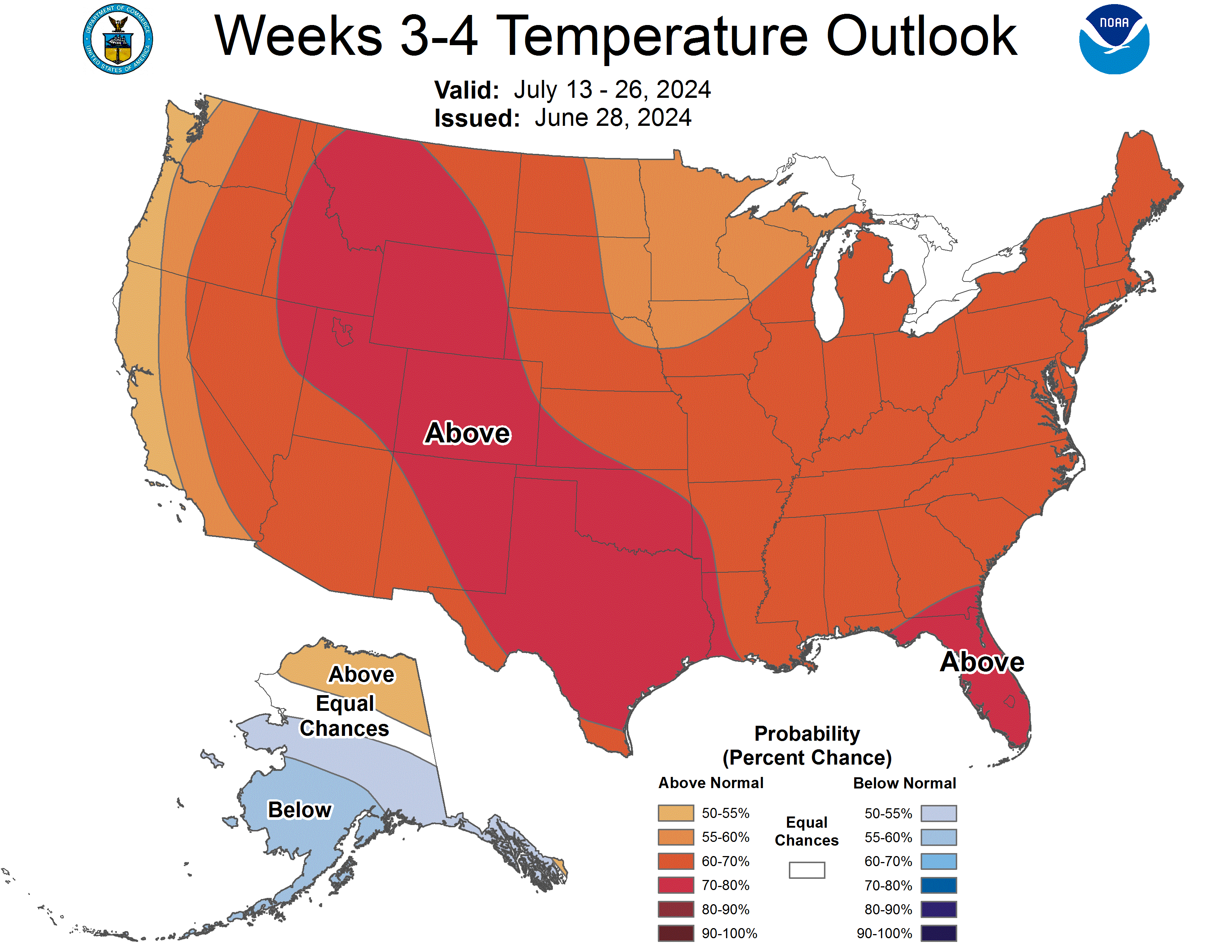
Temperature Probability
|
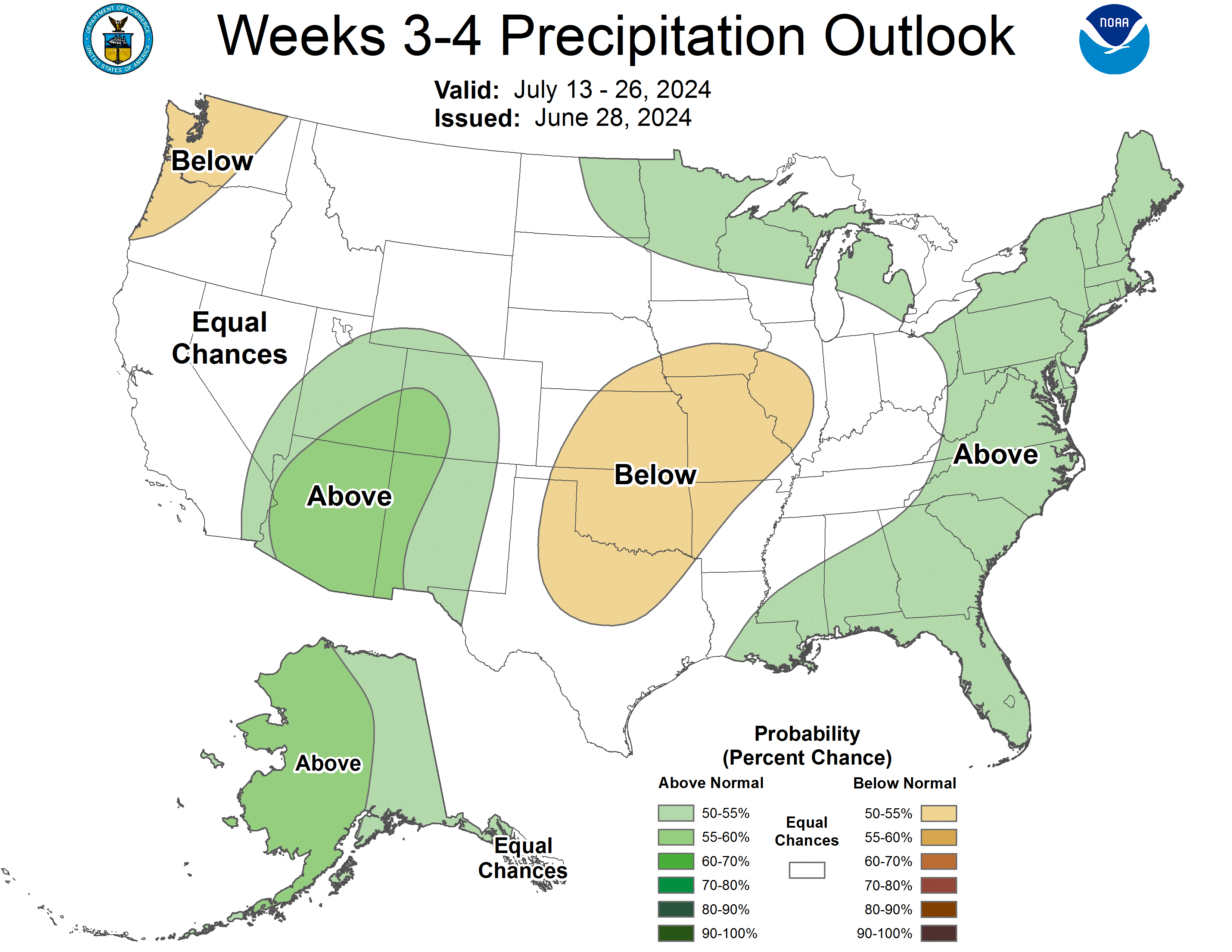
Precipitation Probability
|
Week 3-4 500-hPa Height Outlook
|
|
Click HERE for info about how to read Week 3-4 outlook maps
|
|
|
Prognostic Discussion for Week 3-4 Temperature and Precipitation Outlooks
NWS Climate Prediction Center College Park MD
300PM EDT Fri Sep 11 2026
Week 3-4 Forecast Discussion Valid Sat Sep 26 2026-Fri Oct 09 2026
The Weeks 3-4 Temperature and Precipitation Outlooks issued this week are based on dynamical and statistical model guidance, teleconnections, temperature and precipitation trends, and local sea surface temperature (SST) anomalies.
Relative SST anomalies in the equatorial Pacific are nearing +2.0°C, as the El Niño heads into strong territory. Current and forecast Outgoing Longwave Radiation (OLR) anomalies indicate a low-frequency negative anomaly (indicating enhanced convection) near, and just east of, the International Date Line, and a corresponding positive anomaly (indicating suppressed convection) over the Maritime Continent. This is consistent with warm SSTs associated with El Niño. El Niño forcing will likely continue to impact the Contiguous United States (CONUS) heading into October.
The Madden Julian Oscillation (MJO) is not much of a factor this week, with anomalous convection in the Phase 1 region but very weak. Most guidance suggests either propagation into phases 2 and 3 with very weak amplitude, or a complete suppression of the MJO wave over the coming weeks. Either way, the MJO signal is unlikely to play a major role in driving extratropical teleconnections for the foreseeable future.
There is some agreement in the dynamical model guidance for the broad-scale features on the weeks 3-4 500-hPa geopotential height forecast, although there are regions, especially over the northeastern Pacific Ocean, where substantial differences are seen. All models agree on a deep trough southeast of Greenland, with ridging upstream over eastern Canada. Most guidance also suggests anomalous ridging extending across Canada, with a substantial proportion of the guidance also indicating high height anomalies extending all the way to the far northeastern Pacific. Some guidance also forecasts a deep trough centered near or south of the Aleutian Islands.
The Temperature Outlook for weeks 3-4 indicates enhanced probabilities of warmer-than-normal temperatures over Hawaiʻi, Alaska, along the west coast of CONUS, as well as extending along the Gulf Coast and up the eastern seaboard to the mid-Atlantic. Equal chances of above-, near-, or below-normal temperatures are indicated across most of the central and northeastern regions of CONUS, due to the uncertainty associated with the exact placement and amplitude of the maximum in the 500-hPa ridging over Canada.
The Precipitation Outlook for the Weeks 3-4 period indicates heightened chances of drier-than-normal conditions over the coastal Pacific Northwest, northern New England, and the southern tip of Florida. Enhanced probabilities of wetter-than-normal conditions are favored over the Hawaiʻian Islands from Oʻahu eastward, over all but far northeastern and southeastern Alaska, and over the Desert Southwest and the Rocky Mountains regions, extending eastward across the Ohio and Tennessee Valley regions and to the Atlantic Coast.
Forecaster: Michael Goss
The next week 3-4 outlook will be issued on Friday, Sep 18, 2026
These outlooks are based on departures from the 1991-2020 base period
These are three category outlooks consistent with what is currently used for the monthly and seasonal forecasts.
The shading on the temperature map depicts the most favored category, either above-normal (A), below-normal (B), or near-normal (N) with the solid lines giving the probability ( >33%) of this more likely category (above, below, or near).
The shading on the precipitation map depicts the most favored category, either above-median (A), below-median (B), or near-median with the solid lines giving the probability ( >33%) of this more likely category (above, below, or near).
In areas where the likelihoods of 2-week mean temperatures and accumulated precipitation amounts are similar to climatological probabilities, equal chances (EC) is indicated.
|
|
|
|
An ASCII (w/ HTML markup tags) text version of the written forecast is available.
|
|
|
 www.nws.noaa.gov